
Audience: Designed for college students interested in global politics and history, as well as human rights professionals seeking a deeper, critical understanding of border systems and their ethical implications.
Role: Instructional Design, eLearning Development, Visual Design, Storyboarding, Action Mapping, Prototyping
Tools Used: Articulate Storyline, Adobe Creative Cloud, Figma, Adobe XD, Synthesia, Veed.io
The Need
This project addresses the need for a critical, historical, and multidisciplinary exploration of border systems that moves beyond simple political narratives. The complexity of modern borders—involving ancient history, U.S. policy, advanced technology, environmental impact, and social justice—demands a structured learning experience that connects these disparate elements. Our goal is to equip learners with the critical thinking skills to analyze borders as reflections of deeper systems of inequality and state power, ensuring the learning sticks.
The creation of the course content involved consulting various academic sources and historical documents to serve as the subject-matter expert (SME) literature for this project.
The Process
To guide the course structure, I first performed a content analysis of the core themes: Origins, Expansion, U.S. History, Walls & Surveillance, Technology, and Inequality. Given my passion for turning complex information into visual explorations, I structured the micro-course into six distinct modules to provide a clear, linear progression for the learner.
I observed that complex historical and theoretical content can often overwhelm learners. To address this and make learning stick:
- I segmented the content to ensure each module was tightly focused (e.g., separating “Walls” from “Technology” but showing their historical connection).
- I designed the learning experience to be interactive by pairing dense critical readings with Interactive Resources (like timelines, maps, and satellite imagery analysis) to provide a necessary visual exploration and break from text.
- The Discussion Prompts and Final Projects were structured to move beyond simple recall, requiring students to assess and critically evaluate the content, which aligns with the goal of developing new skills and improving performance (critical thinking).
The scenario for the course is based on the idea that learners should ultimately be able to assess the modern border landscape, leading to the culminating module on inequality and state power.
Text- Based Storyboard and Visual Mockups
After the approval of the action map, I began working on a text-based storyboard that detailed the structure of each module, including:
Specifications for the Interactive Resources (e.g., “Interactive timeline graphic of U.S. Immigration Laws,” “Annotated satellite image showing a border wall with sensor integration”). These visual ideas were key to the “turning complex information into visual explorations” goal.
Learning Objectives and Discussion Questions for each module.
Detailed descriptions of the Critical Readings and their focus.
Interactive Prototype
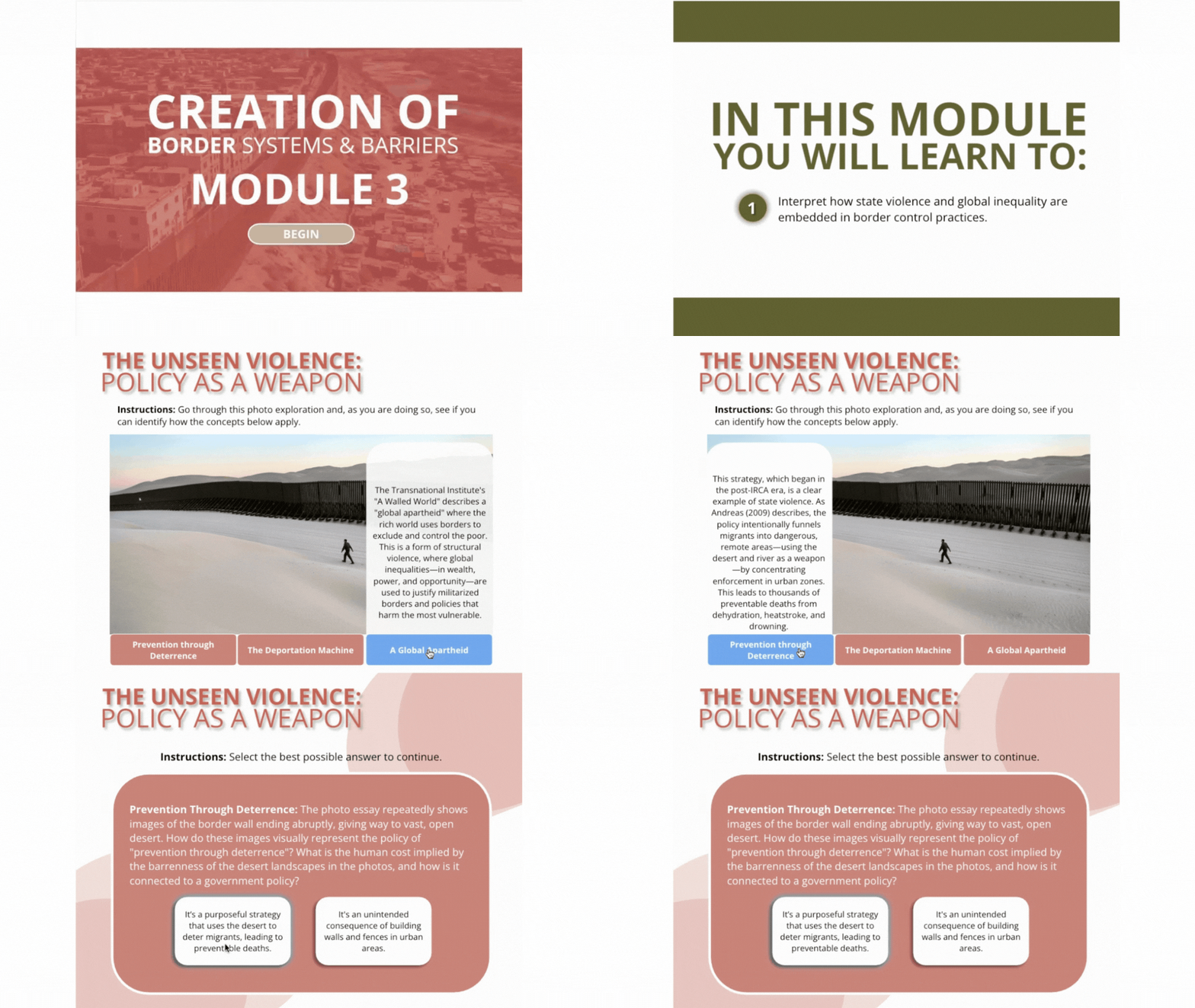
I created an interactive prototype using Articulate Storyline 360 to test the navigation, visual theme, and flow. The prototype included:
- The Course Introduction and Learning Objectives page.
- A sample of Module 2: The Modern State and Border Expansion, including the reading link and the interactive map component.
- The Assessment/Discussion Forum structure to ensure the critical engagement points were functional and clear.
I received feedback on the user experience and visual design to ensure the complex academic content was presented in an engaging and accessible format.
Full Development
After collecting feedback and applying iterations, I started to develop the project in full. The project consists of six fully-developed modules built within a learning management system (LMS) or a development tool like Articulate Storyline 360. Content involved integrating external critical readings, embedding custom-created interactive timelines/maps, and ensuring the discussion prompts were clearly integrated to facilitate the learner engagement necessary for the content to stick.
 camilondono.com